
Efficient Inbound Operations Set the Pace for Your Entire Supply Chain
Inbound operations in warehouse environments are the processes that happen from the moment a truck backs into your dock to the moment that inventory is stored and ready to ship. Get this right, and everything downstream runs smoother. Get it wrong, and the errors compound fast.
Here is a quick breakdown of what inbound warehouse operations actually cover:
| Stage | What Happens |
|---|---|
| Dock Scheduling | Carrier appointments are booked and dock doors are assigned |
| Unloading | Freight is physically removed from trailers |
| Verification | Shipments are checked against purchase orders and ASNs |
| Inspection | Goods are examined for damage and compliance |
| Putaway | Inventory is moved to its designated storage location |
| System Update | WMS records are updated in real time |
Most warehouse improvement conversations focus on picking speed and outbound fulfillment. That focus makes sense on the surface, but it creates a blind spot. The reality is that most inventory errors, fulfillment delays, and labor inefficiencies trace back to problems that started at the receiving dock, not the pick face.
A single receiving error, a wrong batch recorded, a misplaced pallet, or a missing lot ID can ripple through every downstream process. Fixing it after the fact costs significantly more than catching it at the dock.
My name is Cole Russell, and I grew up around the logistics industry before spending the last five years focused on protecting my partners’ operations through smarter, more transparent supply chain execution. Understanding inbound operations in warehouse settings is foundational to everything Hanzo does, and this guide will walk you through exactly how to get it right.
Must-know inbound operations in warehouse terms:
Efficient inbound operations set the pace for your entire supply chain
Think of your receiving dock as the command center for your entire facility. It is the first point of data capture. If the data entering your system is wrong, every decision made afterward will be flawed. In 2019, U.S. businesses spent $1.63 trillion on logistics, which was about 7.6% of the GDP. For many companies, logistics costs account for 11% of their total revenue. With transportation and inventory taking up 72% of that spend, you cannot afford to have a bottleneck at the very beginning of the flow.
High performing warehouses treat the dock as a coordinated system rather than just a place where trucks show up. When inbound operations in warehouse workflows are optimized, they act as a strategic lever. For one industry partner, focusing on dock efficiency nearly doubled their throughput while reducing breakage by 69%. That is the difference between a reactive warehouse and a proactive one.
Efficient inbound flows ensure that inventory is available for sale the moment it hits the rack. If your dock-to-stock time is slow, you are sitting on “dead” capital that could be fulfilling orders. In our Indianapolis hub, where speed is a requirement for industries like life sciences and automotive, we see how a controlled inbound process prevents the chaos of dock congestion and labor waste.
Master the core steps of the inbound process to prevent downstream errors
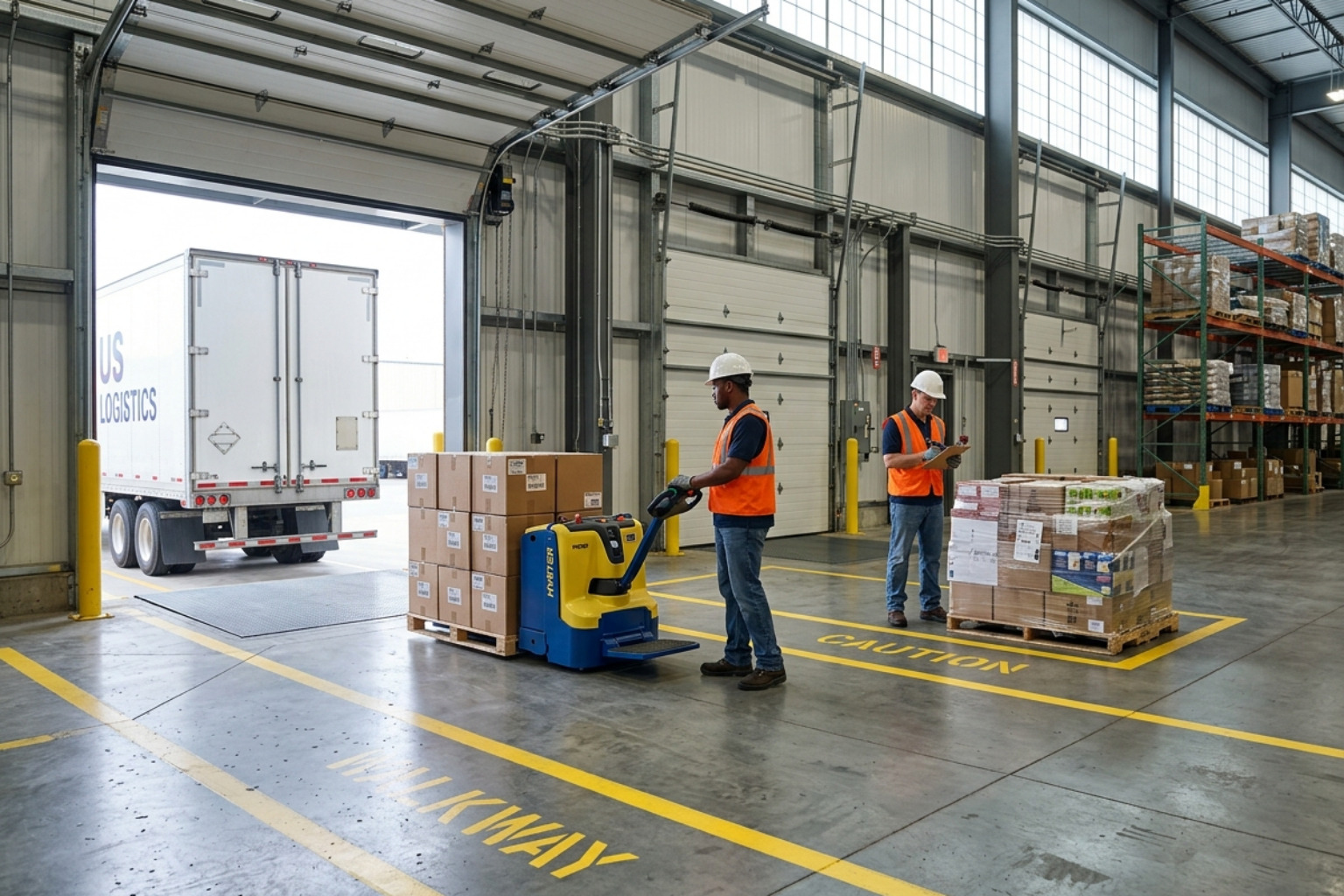
The inbound journey is more than just moving boxes. It is a sequence of events that must be followed with precision to maintain inventory integrity. We break this down into several critical stages that ensure nothing is lost or mislabeled.
The first step is dock scheduling. You should never operate on a first come, first served basis at an enterprise scale. This leads to yard congestion and driver detention fees. By using appointment based scheduling, we can align our labor levels with the expected volume, ensuring we have the right team ready when the trailer arrives.
Once the truck is at the dock, unloading begins. This is where standardized processes are vital. Our teams follow specific workflows to ensure safety and speed. After the goods are off the truck, we move into verification and inspection. This is the “firewall” of the supply chain. We check what arrived against the purchase order to ensure we received exactly what we expected.
Understanding the balance between Warehouse Operations: Inbound and Outbound Flows is essential. While outbound is about meeting customer demand, inbound is about securing the supply. If you are debating Logistics 101: Outsourcing to a 3PL vs Managing Your Own Warehouse, a specialized partner often has the infrastructure to handle these steps with much higher accuracy than a DIY setup.
Standardize receiving for better inbound operations in warehouse
Receiving is where assumptions meet reality. To get this right, we use a three-way match system. We compare the physical goods received against the packing slip and the original purchase order. This prevents us from paying for items we did not get or storing items that were never ordered.
Using an Advance Shipping Notice (ASN) is one of the best ways to speed up this process. An ASN tells us exactly what is on the truck before it even reaches Indianapolis. When the truck arrives, we can use barcode scanning to quickly verify the contents and update our records in real time. This digital trail is the backbone of Inbound Warehouse Operations: Best Practices for Enterprise-Scale Receiving because it eliminates the manual data entry errors that plague many operations.
Optimize putaway to reduce travel time for picking teams
Putaway is the final step of the inbound process, but it is the first step of a successful pick. If you put a high velocity item in the back corner of a 2 million square foot facility, you are forcing your pickers to travel further than necessary for every single order.
We use directed putaway logic. This means our system suggests the best location for an item based on its size, weight, and how fast it sells (SKU velocity). Fast moving items go in easy to reach storage zones near the shipping area, while slower items move to higher racks or further aisles.
A good 3PL Warehouse Management System helps us manage these zones automatically. By organizing our pallet racks this way, we reduce travel time and maximize our vertical space, which is critical for scaling brands that need to grow without expanding their physical footprint.
Solve common challenges in inbound operations in warehouse
Even with a great plan, the real world throws curveballs. The most common challenges we see include dock congestion, vendor non-compliance, and labor planning.
Dock congestion usually happens when there is a lack of visibility. If three trucks show up at once without an appointment, your team is overwhelmed and errors start to happen. Vendor non-compliance is another silent profit killer. This happens when suppliers send shipments with missing labels, incorrect quantities, or damaged packaging. Every time we have to stop and fix a vendor’s mistake, it adds cost to the operation.
Labor planning is the third hurdle. Inbound work is physically demanding and requires consistent execution. If you don’t have enough people, trailers sit in the yard. If you have too many, you are wasting money on idle time. We solve this by using data to predict our needs and maintaining a highly trained, flexible workforce. Avoiding 5 Inventory Management Mistakes That Could Be Costing You starts with recognizing that your receiving dock is where your inventory accuracy is won or lost.

Track the right metrics to measure performance and accuracy
You cannot improve what you do not measure. In our warehouses, we focus on a few key performance indicators (KPIs) that tell the real story of our inbound health.
- Dock to Stock Time: This measures how long it takes from the moment a truck arrives until the goods are put away and ready for sale. The shorter this time, the better your cash flow.
- Receiving Accuracy: This is the percentage of shipments received without errors. We aim for 99% or higher.
- Supplier Compliance Rate: We track how often our suppliers meet our shipping requirements. This allows us to have honest conversations with vendors about their performance.
- Inventory Turnover: This shows how quickly we are moving through our stock.
By taking a data-driven approach to optimize inventory, we can identify bottlenecks before they become major problems. If we see dock to stock times creeping up, we can investigate whether it is a staffing issue or a layout problem.
Use technology and specialized workflows to accelerate throughput
Technology is the multiplier for human effort. In a modern warehouse, we use tools like RFID and mobile barcode scanners to ensure that every touchpoint is recorded. This provides the transparency our partners need to see their inventory levels in real time.
We also use specialized workflows like cross-docking. Cross-docking is when we take goods directly from the receiving dock and move them to the shipping dock with little to no storage time in between. This is perfect for high volume items or backordered products that need to get to customers immediately. It reduces handling costs and speeds up the entire supply chain.
Last mile services account for 41% of overall supply chain costs. By optimizing our inbound processes and using cross-docking where it makes sense, we can help reduce the total cost of getting a product to the end user. To see how these pieces fit together, it helps to understand what modern inventory management looks like today.
Integrate returns into your inbound operations in warehouse flow
Returns, or reverse logistics, are often treated as a nuisance, but they are actually an opportunity. When a return comes back to the warehouse, it enters the inbound flow just like a new shipment. It needs to be inspected, categorized, and recorded.
We look for salvageable items that can be refurbished and put back into inventory. This reduces waste and recovers value for our clients. A smooth return process is a major benefit of outsourcing warehouse operations, as we have the dedicated space and staff to handle quality control audits that might be too time consuming for a brand to manage in house.
Common questions about warehouse receiving and storage
What is the difference between inbound and outbound logistics
Inbound logistics focuses on the supply side. It is the movement of raw materials or finished goods from a supplier to our warehouse. The focus is on receiving, inspection, and storage. Outbound logistics focuses on the demand side. It is the process of picking, packing, and shipping those goods to the final customer. While inbound ensures the shelves are full, outbound ensures the customer gets their order on time.
How do you reduce dock-to-stock time
The best way to reduce dock to stock time is through preparation and technology. Using ASNs allows us to prepare for a shipment before it arrives. Standardizing the unloading process and using directed putaway ensures that once the goods are off the truck, they move to their final location without hesitation. Eliminating manual paperwork and using mobile scanners also removes the time lag between physical movement and system updates.
Why is inbound accuracy more important than picking speed
If your picking speed is fast but your inbound data is wrong, you are just picking the wrong items faster. A single error at the receiving dock can lead to stockouts (even if the system says you have stock) or shipping the wrong product to a customer. Fixing an error at the receiving stage costs pennies. Fixing that same error once it reaches a customer can cost 10 to 50 times more in shipping, labor, and brand reputation damage.
Partner with a strategic 3PL to scale your inbound capacity
Managing inbound operations in warehouse facilities requires a mix of specialized infrastructure and strategic expertise. At Hanzo Logistics, we provide exactly that from our Indianapolis hub. We know that for our partners in the automotive and pharmaceutical industries, precision is not just a goal; it is a requirement.
We offer 2 million square feet of space and a team that understands how to handle the high stakes of regulatory audits and seasonal peaks. We replace the “information vacuum” common in logistics with real-time data and proactive problem solving. Whether you are dealing with complex life sciences storage or high volume industrial products, we have the engine to support your growth.
If you are ready to stop worrying about dock congestion and start focusing on scaling your brand, we are here to help. Our team provides the 24/7 availability and technical skill needed to keep your supply chain moving.
Learn more about how Hanzo Logistics can streamline your operations